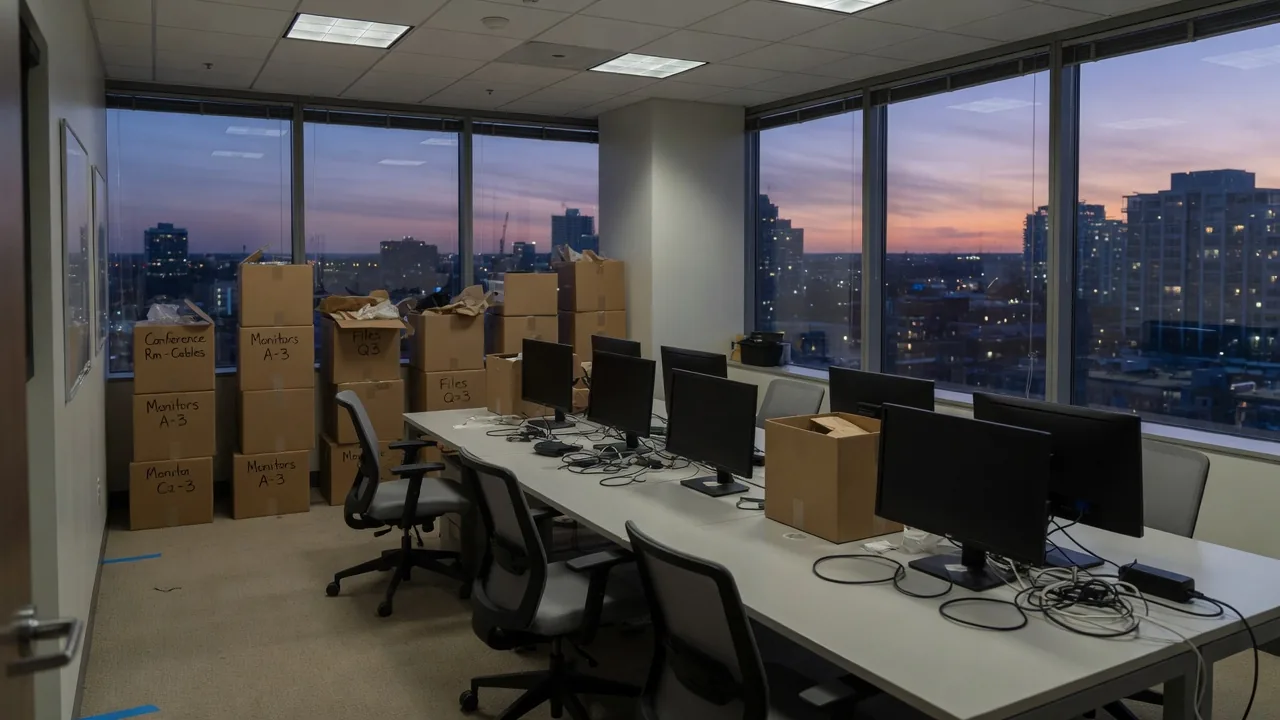
When a business relocates, every hour of downtime costs money. Lost productivity, missed calls, delayed shipments, frustrated customers — the meter starts running the moment you close the doors at your old location. The key to a successful commercial move isn't just getting everything from point A to point B; it's doing it with minimal disruption to your operations. Here's how to make that happen.
Start Planning 3-6 Months in Advance
Commercial moves are exponentially more complex than residential ones. A 10,000 square foot office involves thousands of items, specialized equipment, IT infrastructure, and the coordinated schedules of dozens (or hundreds) of employees. Give yourself the runway you need.
- Assign a move coordinator — one person from your team who serves as the single point of contact with the moving company
- Form a move committee with representatives from each department
- Create a floor plan for the new space showing where every desk, workstation, and piece of equipment will go
- Inventory everything — know exactly what's moving, what's being replaced, and what's being discarded
- Set a realistic timeline with built-in buffer days for unexpected complications
Choose a Mover with Commercial Experience
Residential and commercial moves are fundamentally different operations. Your moving company should have documented experience with:
- Cubicle and furniture systems — disassembly, transport, and reassembly of modular office furniture
- IT equipment — servers, networking hardware, copiers, and sensitive electronics
- After-hours and weekend moves — most commercial moves happen outside business hours
- Multi-floor logistics — elevator scheduling, stair carries, freight loading docks
- Coordination with building management at both the origin and destination
At Manchester Movers, our commercial moving division has relocated offices, schools, medical facilities, and retail operations across Connecticut for decades. We understand that your business can't afford to miss a beat.
IT Infrastructure: The Critical Path
For most businesses, the IT infrastructure is the single most important element of the move — and the one most likely to cause extended downtime if mishandled.
- Engage your IT team (or provider) early — they need to plan network infrastructure at the new location months before the move
- Back up everything before the move — full system backups, not just incremental
- Label every cable, port, and connection at the current location
- Have the new location pre-wired — data drops, power circuits, and phone lines should be ready before furniture arrives
- Plan for a parallel operation period if possible — keep systems running at the old location until the new site is verified
- Test everything before employees arrive — internet, phones, printers, VPN access
The most successful commercial moves we've handled share one thing in common: IT was ready at the new location before the first truck arrived.
Consider a Phased Move
Instead of moving everything in one massive operation, consider a phased approach:
- Phase 1: IT infrastructure and server room (usually done on a weekend)
- Phase 2: Non-essential departments that can work remotely temporarily
- Phase 3: Core operations and customer-facing teams
- Phase 4: Final items, storage cleanout, and old-location restoration
A phased approach keeps parts of your business operational throughout the move. It's more complex to coordinate, but the reduction in total downtime is usually worth it.
Communicate With Every Stakeholder
A commercial move affects more people than just your employees. Make sure you communicate with:
- Employees: Give them a detailed timeline, their responsibilities, and clear instructions for packing their personal items and workstations
- Clients and customers: Notify them of the move date, any service interruptions, and your new address well in advance
- Vendors and suppliers: Update delivery addresses, billing information, and contact details
- Building management: Coordinate elevator reservations, loading dock access, and move-in/move-out rules at both locations
- Insurance providers: Update your business address and verify coverage during the move
Minimize Employee Disruption
Your employees are your most important asset during a move. Help them stay productive:
- Allow remote work on moving day and the day after — if your business supports it
- Provide labeled boxes and instructions for packing personal items and desk contents
- Number every workstation in the new floor plan so employees know exactly where they'll be
- Stock the new break room before employees arrive — coffee, snacks, and basic supplies go a long way
After the Move: The First Week
The work doesn't stop when the last box is delivered. The first week in your new space sets the tone.
- Have IT on-site for the first two days to troubleshoot connectivity issues
- Conduct a walkthrough to verify everything arrived and is placed correctly
- Collect feedback from employees — fix ergonomic and workflow issues quickly
- Update your online presence — Google Business Profile, website, social media, directory listings
- Send a "we've moved" announcement to your full contact list
Don't underestimate the morale boost of a well-organized move. When employees walk into a functional, clean, organized new space on Day One, it sets a positive tone for months.
Let's Plan Your Commercial Move
Manchester Movers has been relocating Connecticut businesses since 1968 — from small offices to entire school buildings. We work after hours, on weekends, and on your schedule to minimize disruption to your operations.
Request a free commercial moving quote or call (860) 646-3333 to speak with our commercial moving coordinator.